America as an imagined escape and future
A Pale View of HillsAmerica as an imagined escape and future is the hopeful destination Sachiko presents for herself and Mariko, but its meaning shifts as her circumstances change. At first it promises opportunity, independence, and a new life already made familiar through language; later, Sachiko describes it as a foreign place that could unsettle her daughter and considers returning to Japan. The contrast makes America less a settled destination than a future onto which Sachiko places competing hopes and fears.
Announcement and Promise
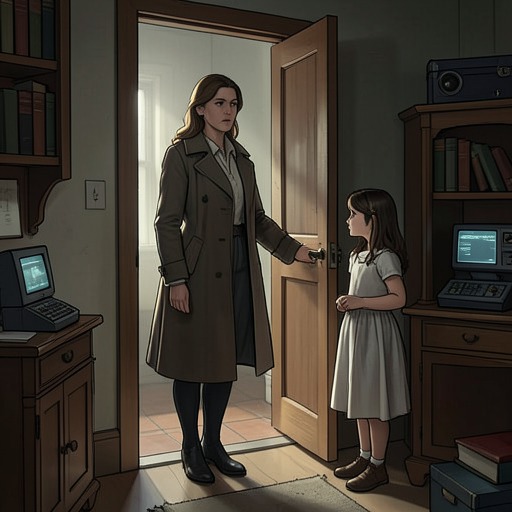
While Etsuko is concerned about Mariko and asks whether she may be with friends, Sachiko laughs, touches Etsuko’s arm, and says that everything has finally been settled: they will leave for America within days. The announcement stops Etsuko in mid-stride. Its timing matters: a conversation driven by alarm about Mariko is suddenly redirected toward Sachiko’s plans, and America arrives first as surprising news rather than as a carefully explained destination.
Sachiko gives the plan a firm timetable. Frank will collect them in his car within the next few days, and they expect to be on a ship by the end of the week. She treats departure as sufficiently certain that she will no longer need to work at Mrs. Fujiwara’s noodle shop. The car, ship, and approaching deadline give a concrete outline to a future otherwise described in expansive terms. America is not merely an idea in this exchange; it is presented as a move about to happen.
Yet the certainty is also rhetorical. When Etsuko raises the difficulties of a different country, language, and customs, Sachiko insists that she already knows a great deal about America, speaks English with Frank, and will manage. She acknowledges occasional moments of doubt, then returns to confidence. The repeated assurance that she can cope makes self-belief part of the plan: the imagined future depends not only on reaching America but on Sachiko’s ability to picture herself as capable there.
Language, Independence, and Possibility
Sachiko’s confidence in English has a personal history. Her father spoke it well, had connections in Europe, and encouraged her to study it. After she married, however, her husband forbade her to continue and took away her English books. Sachiko says that she did not forget the language; meeting foreigners in Tokyo brought it back. She now speaks English with Frank because his Japanese is poor. The language that makes America seem accessible is therefore also connected to a period of learning and a capacity her marriage had tried to restrict.
She imagines that living in America will allow her to speak like an American woman, and Frank’s account of what might be possible there widens the horizon further. Sachiko says that she might become a businesswoman; Mariko, she suggests, could become a businesswoman or even a film actress. These possibilities are not described as outcomes already secured. They are examples of the open future Sachiko associates with America, where a woman’s life need not remain confined to the roles she knows in Japan. Her promise is powerful partly because it is so capacious: America can stand for several different forms of freedom at once.
Etsuko rejects the suggestion that she is envious and describes a different future as satisfactory: Jiro’s work is going well, and the child is arriving when they wanted it. The contrast is not simply between ambition and contentment. Sachiko describes opportunity beyond her present life, while Etsuko names the stability of her family’s existing circumstances. Their exchange shows that America’s appeal is specific to Sachiko’s vision, not a universal measure of what a good future must be.
Mariko and the Cost of the Future
Etsuko’s question about the move is not only whether Sachiko can adapt; she asks what will become of Mariko. Sachiko initially answers by insisting that her own language skills and confidence will carry her through, and only then addresses her daughter. She argues that America offers Mariko more opportunities and a better life for a woman. In this version of the plan, emigration is maternal provision: Sachiko imagines that a new country can enlarge the choices available to her child as well as to herself.
A later conversation complicates that confident account. Sachiko says that she intends to write to her uncle, explain her whereabouts and circumstances, and discuss the possibility of returning to his house. She now describes America as a land full of foreigners and imagines how confusing it would be for Mariko to have an American father. She reasons that her daughter has already experienced enough disturbance and deserves somewhere settled. The destination once presented as a source of opportunity is now also a possible source of further disruption.
This shift exposes the tension within Sachiko’s maternal argument. America can represent a better life for Mariko, but it can also mean another unfamiliar setting and another change in family circumstances. Sachiko presents both positions as expressions of responsibility: leaving is justified by the opportunities she expects America to offer, while considering a return is justified by her daughter’s need for stability. Neither account erases the other, and the evidence does not make the decision a simple choice between maternal care and selfish ambition.
An Unsettled Destination
Sachiko’s later explanation connects the changed situation to Frank’s fear of responsibility for Mariko. She says that her daughter comes first and that Frank is scared of her. The contrast between the earlier departure plan and the later possibility of returning to her uncle therefore involves more than a revised opinion of America: it also reveals a strain in the proposed family future. The excerpts establish that Sachiko is reconsidering the destination and its consequences, rather than providing a full account of what ultimately happens to the plan.
America consequently remains both a place and an imagined answer. Sachiko associates it with English, work, and possibilities unavailable to women in her present life, then acknowledges the foreignness and instability it may impose on Mariko. Her repeated confidence does not settle these contradictions; nor does her later willingness to return make her earlier hopes meaningless. The idea’s significance lies in that unresolved double meaning: America offers Sachiko a way to imagine escape and reinvention, while the practical questions of motherhood, belonging, and Frank’s commitment keep that future uncertain.